
Views: 222 Author: 3BU Technology Publish Time: 2026-05-10 Origin: Site


Carbon fiber orthotics generally deliver higher energy return and a snappier toe-off for marathon sprinters, while nylon orthotics offer a more forgiving, versatile ride that many competitive—but not elite—runners find easier to handle over 42.2 km. [run4it]
As both a long-distance runner and a product strategist working with performance insoles, I've felt firsthand how a plate material can make or break a marathon. In real-world testing and lab data, carbon fiber plates clearly improve running economy and energy return, but they are not automatically the best choice for every marathon sprinter, especially when we factor in biomechanics, course profile, injury history, and training volume. [smart.dhgate]
From the manufacturing side, Chinese OEM specialists like 3BU Technology now combine carbon fiber or nylon plates with multi-layer foams (EVA, PU, TPU) to fine‑tune stiffness, cushioning, and durability for different brands and runner profiles. This means the "better" material is less about theory and more about matching plate behavior to the athlete's stride and race goals. [cambridgephysio]

Energy return describes how much of the energy you put into the ground comes back to propel you forward instead of being lost as heat or excessive deformation. [supwell]
- Carbon fiber plates increase longitudinal bending stiffness, helping the foot roll forward and improving the efficiency of push‑off. [pmc.ncbi.nlm.nih]
- Nylon (or nylon‑composite) plates are more flexible, offering a smoother, less aggressive rebound that still supports propulsion but emphasizes comfort and shock absorption. [alibaba]
Recent research on plated shoes shows mean metabolic savings of around 2–3%, which translates to roughly 1% faster marathon times, though not all of this gain comes from the plate alone—foam and geometry play a major role. For a 3‑hour marathoner, this can still mean several minutes off their finish time when shoe setup is optimized. [runrepeat]
From an athlete's perspective, carbon fiber orthotics feel springy, rigid, and laser‑focused on propulsion. [supwell]
- Very high bending stiffness for a strong lever effect at toe‑off. [pmc.ncbi.nlm.nih]
- Lightweight structure, helping reduce cumulative fatigue over 42 km. [cambridgephysio]
- Strong stability in the sagittal plane, which can improve running economy for runners with a consistent, forward‑driven gait. [supwell]
Custom orthotics and racing shoes using carbon plates are widely recommended for performance‑centric runners who want maximal responsiveness. In practice, this works best for marathon sprinters who can maintain a relatively high pace and stable form throughout the race. [run4it]
Advantages for marathon sprinters: [alibaba]
- Noticeable snap and propulsion at toe‑off.
- Lower perceived effort at race pace due to improved running economy.
- Better performance payoff for runners who surge in the final 10–15 km.
Trade‑offs and risks: [running-orthotics-sydney]
- High stiffness can feel harsh at slower paces or during easy long runs.
- Mis‑matched stiffness plus poor form may shift load to the calf, Achilles, or forefoot.
- Carbon plates can be more fragile under torsional or extreme bending stress.
As a UX‑oriented product strategist, I often advise brands to reserve full‑carbon plates for elite or sub‑elite marathoners, or for experienced runners who understand how to adapt their training and gait to this aggressive setup. [run4it]
Nylon and nylon‑composite plates are less rigid than carbon fiber and provide a more forgiving ride over long distances. [smart.dhgate]
- Moderate stiffness that still aids toe‑off but allows more natural flex. [running-orthotics-sydney]
- Improved shock absorption when paired with EVA or PU midsoles. [smart.dhgate]
- Greater tolerance for uneven roads, cambered streets and changing pace. [alibaba]
In side‑by‑side run tests, experienced testers often report that nylon plate shoes feel less "explosive" but more comfortable and controllable over long races. This can be a decisive factor for marathon sprinters who must manage fatigue and form over hours, not seconds. [cambridgephysio]
Advantages: [running-orthotics-sydney]
- Smoother transition and more natural foot motion.
- Better day‑to‑day comfort, reducing irritation and hotspots.
- Often more durable under flex fatigue and lateral loading.
Limitations: [runrepeat]
- Slightly lower peak energy return compared to a well‑tuned carbon plate.
- Less dramatic "race‑day only" feeling, which some athletes actually miss psychologically.
For brands targeting high‑volume, ambitious marathon runners rather than only elites, nylon plates can deliver a better UX balance of propulsion, comfort, and injury risk control. [smart.dhgate]
Factor | Carbon fiber orthotics | Nylon orthotics |
|---|---|---|
Energy return | Highest, strong lever effect at toe‑off supwell | Moderate‑high, smoother rebound smart.dhgate |
Ideal pace range | Faster, stable marathon paces and finishing sprints run4it | Wide pace range from tempo to easy long runs smart.dhgate |
Comfort over 42 km | Can feel harsh or demanding for some runners supwell | Generally more forgiving and comfortable smart.dhgate |
Injury risk if mis‑matched | Higher (calf, Achilles, forefoot overload) supwell | Lower, more tolerant of form fluctuations smart.dhgate |
Durability of plate | Stiff but more prone to cracking under abuse smart.dhgate | Better flex‑fatigue resistance smart.dhgate |
Best for | Elite/sub‑elite, aggressive race strategies run4it | Competitive amateurs, mixed‑pace training & racing smart.dhgate |
In short, carbon fiber wins on pure energy return, while nylon wins on practical usability and comfort for a broader range of marathon sprinters. [pmc.ncbi.nlm.nih]
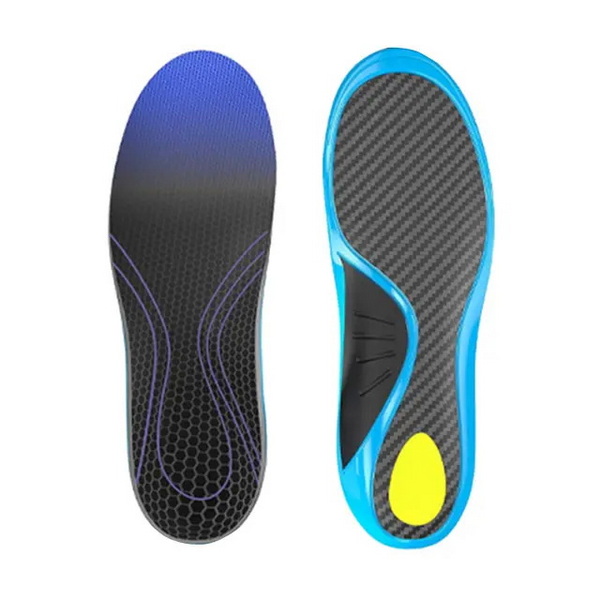
3BU Technology has more than 12 years of insole R&D and production experience, with a 5000㎡ factory and over 100 skilled workers serving global insole brands through OEM and ODM services. The company's portfolio already includes carbon fiber insoles, EVA insoles, PU insoles, orthotic insoles and heat insoles, which provides a rich material library for combining plates with cushioning layers. [insolemaker]
Key capabilities that matter for marathon orthotics:
- Automatic injection and CNC cutting to keep plate geometry and stiffness consistent across large volumes. [insolemaker]
- Multi‑layer lamination to bond carbon or nylon plates with EVA, PU, and textiles for tailored flex profiles. [insolemaker]
- In‑house compression and bending tests to ensure the plate's stiffness and rebound stay within spec after repeated loading. [insolemaker]
From an OEM UX standpoint, this allows 3BU to turn brand requirements—race distance, target runner level, desired feel—into a tuned plate‑plus‑foam system rather than a one‑size‑fits‑all solution. [foam-well]
Based on current market trends and lab data, typical setups that brands request include: [insolemaker]
1. Elite carbon race orthotic
- Full‑length carbon plate with high stiffness.
- Super‑resilient EVA/TPU mid‑layer for rebound.
- Minimal upper thickness to save weight.
2. Versatile nylon marathon orthotic
- Nylon‑composite plate with tuned flex zones at the forefoot.
- Dual‑density EVA/PU for a softer heel and firmer midfoot.
- Breathable cover fabric for long‑race comfort.
3. Hybrid progression orthotic
- Semi‑carbon, semi‑nylon structure to bridge training and race day.
- Slightly lower stiffness to reduce injury risk in heavy blocks.
These configurations are validated with bending tests and, for strategic accounts, long‑run field feedback before mass production. [foam-well]
Recent work on advanced footwear technology confirms that combining compliant foams with a carbon plate reduces metabolic cost by around 2.75% on average, which aligns with earlier models predicting 2–3% savings. Translating this to race performance, researchers estimate roughly 1% improvement in marathon time, though the carbon plate itself is only part of the effect. [runrepeat]
Independent testers comparing carbon and nylon plates report: [alibaba]
- Clearer propulsion and higher cadence with carbon at race pace.
- Slightly higher perceived comfort and versatility with nylon.
- Best outcomes when plate stiffness is matched to runner speed and surface.
As a practitioner working between biomechanics consultants and factories, I treat carbon plates as high‑gain, high‑precision instruments: extremely effective when correctly tuned, but unforgiving when mis‑used. [supwell]
If you are a brand or coach specifying orthotics—or a runner choosing between plate types—this simple framework helps: [run4it]
1. Define target pace and profile
- Sub‑3 or near‑elite runners with efficient form: lean toward carbon fiber.
- 3–4.5 hour, mixed‑pace runners: start with nylon or hybrid plates.
2. Assess injury history and comfort needs
- History of calf/Achilles issues: favor nylon or softer plate setups.
- Strong lower‑leg robustness and good tolerance for stiffness: consider carbon.
3. Consider race course and conditions
- Flat, predictable courses: carbon plate advantage is maximized.
- Hilly, cambered, or uneven surfaces: nylon's flexibility offers better control.
4. Integrate testing into training
- Introduce new plates at least one training cycle before race day.
- Gradually extend long‑run distance in the new orthotics to monitor fatigue and pain.
For OEM buyers partnering with 3BU, these inputs should be translated into plate thickness, curvature, material blend and foam‑layer hardness in the product brief. [insolemaker]
For marathon sprinters who can sustain a high, efficient pace and who train specifically in stiff plated setups, carbon fiber orthotics provide the best energy return and race‑day edge. [pmc.ncbi.nlm.nih]
However, for a large segment of competitive runners who fluctuate in pace, run on varied terrain, or prioritize long‑term joint health, nylon orthotics often deliver better real‑world performance: slightly less raw propulsion, but better comfort, fewer injury flare‑ups, and more consistent usage across training and racing. [cambridgephysio]
Smart brands increasingly offer two‑tier solutions—carbon for peak performance SKUs and nylon for high‑volume "marathon trainer" lines—built on the same last but tuned for different users. [foam-well]
If you are a running shoe brand, sports orthotics label, or marathon coaching organization looking to launch or upgrade performance insoles, partnering with a specialized OEM like 3BU Technology lets you tailor carbon fiber or nylon plate setups to your exact runner profile and price point. [insolemaker]
With proven experience serving world‑class insole brands and a full material toolbox—carbon fiber, nylon composites, EVA, PU, and more—3BU can help you prototype, test and scale a race‑ready orthotic line for marathon sprinters worldwide. Contact the 3BU team to share your target runner, race distance and brand positioning, and turn this comparison into a competitive product advantage. [foam-well]

Q1. Do carbon fiber orthotics really make marathon sprinters faster?
Yes, when combined with advanced foams and proper geometry, carbon plates can reduce metabolic cost by around 2–3%, which can improve marathon times by roughly 1% for suitable runners. [runrepeat]
Q2. Are nylon orthotics "good enough" for serious marathon runners?
For many competitive but non‑elite runners, nylon plates provide sufficient energy return with better comfort and lower injury risk, making them a very practical choice. [running-orthotics-sydney]
Q3. How should brands choose between carbon and nylon plates for their product line?
Brands should map target pace, runner experience, course type and price point, then work with an OEM to tune plate stiffness, material blend and foam layers accordingly. [smart.dhgate]
Q4. Can one runner safely rotate between carbon and nylon orthotics?
Yes, many athletes use nylon‑based orthotics for high‑volume training and reserve carbon plates for key workouts and race day, which balances performance and load management. [run4it]
Q5. What makes 3BU Technology a strong OEM partner for these products?
3BU offers more than a decade of insole manufacturing experience, advanced equipment, multi‑material expertise, and existing partnerships with leading insole brands, making it well‑positioned to develop both carbon and nylon orthotics at scale. [insolemaker]
1. Run4It – Carbon plate running shoes: Are they for me? [run4it]
2. Supwell – Why Carbon Fiber Plated Running Shoes Are So Popular [supwell]
3. DHgate Insights – Carbon plate vs nylon plate running shoes: Is carbon fiber really worth it? [smart.dhgate]
4. Cambridge Physio – Optimize Your Performance: Top Custom Orthotics for Runners [cambridgephysio]
5. Alibaba Product Insights – All About Best Orthotics Running: Specifications, Performance, and Common Uses [alibaba]
6. NIH PMC – Metabolic effects of carbon-plated running shoes [pmc.ncbi.nlm.nih]
7. RunRepeat – Best Running Shoes With A Carbon Plate [runrepeat]
8. Running Orthotics Sydney – Understanding the Materials Used in Custom-Made Running Orthotics [running-orthotics-sydney]
9. 3BU Technology – PU Insole (manufacturing capabilities overview) [insolemaker]
10. 3BU Technology – About Us (company profile and product lines) [insolemaker]
11. Foam‑Well – Top 10 Best Insole Manufacturers in China (3BU profile) [foam-well]


