
Language
Views: 222 Author: 3BU Technology Publish Time: 2026-06-08 Origin: Site


Content Menu
● What Arch‑Specific Insoles Can Do for Your Customers
● Step 1 – How to Identify Arch Type (Simple Methods Your Customers Can Use)
>> High Arches
● Step 2 – Matching Insole Designs to Each Arch Type
>> Insoles for Low Arches: Control and Stability
>> Insoles for Neutral Arches: Balanced Support
>> Insoles for High Arches: Cushion and Pressure Relief
● Step 3 – Other Key Factors That Determine the "Right" Insole
>> Activity Level and Use Scenario
>> Common Foot Conditions to Consider
● Simple Arch‑Type Tests You Can Share With Customers
● When to Recommend Professional Evaluation
● OEM and Private‑Label Considerations for Brands and Wholesalers
>> Why Arch‑Specific OEM Insoles Are a Competitive Advantage
>> Key OEM Questions to Ask Your Insole Supplier
● Practical Fitting Tips You Can Add to Your Product Pages
● Arch Types, Recommended Support, and Typical Insole Features
● Clear CTA – Partner With an OEM Insole Expert
● FAQs About Choosing Arch‑Specific Insoles
Choosing the right insoles for each arch type is not just a comfort decision – it directly impacts customer satisfaction, return rates, and the long‑term reputation of your footwear brand. As an OEM insole manufacturer working with international brands and wholesalers, we see this every day on the factory floor and in long‑term client data. [rei]
In this guide, I'll walk you through how to match insole design to arch type, how to evaluate OEM options, and what to consider if you want to upgrade from generic "one‑shape‑fits‑all" inserts to performance‑driven, arch‑specific insoles.

For most end users, foot pain starts quietly: the wrong insole, worn for months, slowly changes alignment and increases stress on the ankles, knees, and lower back. For footwear brands and importers, that same issue appears as higher return rates, more customer complaints, and poor reviews about "comfort." [rei]
Arch‑matched insoles can help your products:
- Reduce common pain issues related to overpronation and supination
- Improve gait alignment and stability during walking, running, or standing
- Extend the perceived comfort life of shoes (customers feel "new shoe comfort" longer)
- Differentiate your product line with clear, technical comfort benefits
In our OEM projects, brands typically see fewer comfort‑related returns after they switch from flat foam inserts to structured, arch‑specific insoles.
Before you design or source insoles, you need a simple arch‑type framework that your sales team and end users can understand. At a basic level, we work with three arch categories: [algeos]
- Low arches (flat feet)
- Neutral arches
- High arches
People with low arches often see almost their entire footprint when standing on a flat surface. Their shoes tend to wear out faster along the inner edge, indicating overpronation – the inward rolling of the foot during gait. [theinsolestore]
From a product perspective, low arches are closely linked to:
- Increased risk of plantar fasciitis and heel pain
- Fatigue when standing for long shifts
- Knee and hip discomfort due to misalignment
These customers benefit most from firm, structured arch support that helps control overpronation and stabilize each step. [theinsolestore]
Neutral arches show a visible, but not extreme, curve. Shoe wear is relatively even from heel to toe.
Wearers with neutral arches:
- Often have fewer alignment problems in daily life
- Still experience discomfort during high‑impact sports or long standing periods
- Respond well to moderate support plus consistent cushioning [rei]
For this group, your insoles should support rather than aggressively correct – think balanced arch height, flexible structure, and good shock absorption.
High arches leave a footprint where only the heel and ball are clearly visible, with a narrow or missing mid‑foot section. Many of these users also notice more wear along the outer edge of the shoe, which corresponds to supination (rolling outward). [theinsolestore]
Key issues for high‑arch customers include:
- Poor natural shock absorption
- Metatarsal pain (ball of the foot) and forefoot pressure
- Higher risk of stress fractures during running or jumping sports [algeos]
Here, cushioning first is the rule: deep, resilient cushioning and a shaped heel cup to help distribute pressure and protect joints.
Once your target arch profile is clear, you can tailor insole construction, material, and stiffness to each segment. [algeos]
Low‑arch and flat‑footed users need structure and guidance, not softness alone.
For this group, we typically recommend OEM constructions with:
- Firm, pronounced arch support to reduce overpronation
- Semi‑rigid shells (e.g., PP, TPU, or carbon‑fiber composites) for long‑term shape retention [theinsolestore]
- Deep heel cups to stabilize the rearfoot and improve alignment
- Optional medial posting (slightly thicker material on the inside) for performance lines
A practical example: a work‑boot insole that combines a semi‑rigid base with PU foam on top can dramatically improve support for warehouse or construction workers who stand 8–12 hours per day.
For neutral arches, your goal is to maintain rather than aggressively correct.
Recommended features:
- Moderate arch height with a smooth contour
- Multi‑density foam (e.g., a firmer base layer with softer top layer)
- Forefoot cushioning to improve comfort for walking and light running
- Flexible forefoot design to accommodate natural toe‑off
Memory foam or EVA‑based insoles work very well in this segment when combined with a subtle arch and a stable heel base. [rei]
High arches need insoles that absorb shock and relieve localized pressure points. [algeos]
Effective design elements include:
- Thicker cushioning in heel and forefoot (gel, PU, or high‑rebound EVA)
- A contoured heel cup to stabilize the heel and reduce outward rolling
- Optional metatarsal pads to offload pressure in the forefoot
- Slight arch contour to cradle the arch, without forcing it down
In some sports categories (e.g., running, basketball), combining a cushioned mid‑layer with a resilient top fabric (moisture‑wicking, anti‑slip) further improves perceived comfort.
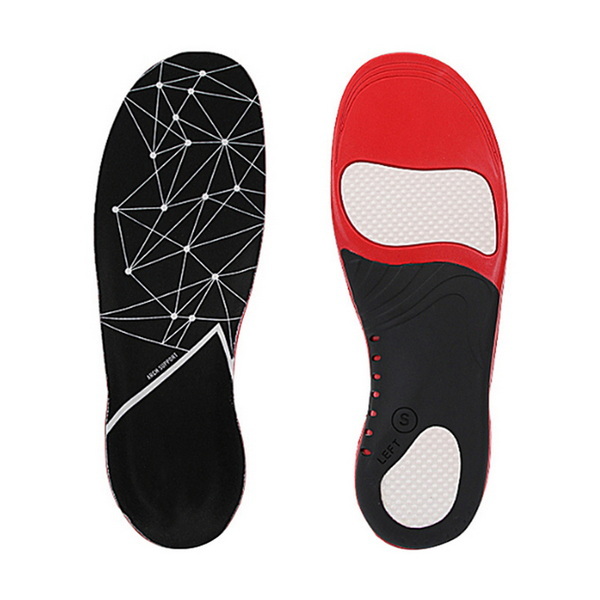
Arch type is the foundation, but it is not the whole story. For OEM projects with international clients, we also consider activity level, foot conditions, shoe fit, and materials. [rei]
Different categories require different performance focuses:
- Running and training: Stability, energy return, impact protection
- Work and safety shoes: All‑day cushioning, anti‑fatigue, anti‑slip top fabrics
- Casual and fashion: Low profile, comfort, compatibility with slimmer shoe silhouettes
High‑impact use generally requires more structure in the heel and mid‑foot, while all‑day standing benefits from larger cushioning zones and ergonomic contouring. [rei]
While insoles are not medical devices, they can help relieve symptoms for common issues. [rei]
- Plantar fasciitis: Needs firm arch support plus added heel cushioning
- Morton's neuroma: Benefits from metatarsal pads that spread the forefoot and reduce nerve compression
- General heel pain: Responds to deep heel cups with soft heel inserts
As an OEM, we frequently integrate modular design elements (removable pads, targeted cushioning zones) so brands can offer specialized SKUs (e.g., "Plantar Fasciitis Relief Insoles").
Incorrect insole volume is an underrated UX problem. [algeos]
- Low‑profile insoles: Best for dress shoes, narrow sneakers, and fashion styles
- Full‑volume insoles: Ideal for athletic shoes, hiking boots, and work boots
For global clients, we usually provide trim‑to‑fit designs and clear size guides (EU/US/UK) so users can cut along guidelines to match their shoe length. Recommending that customers remove the original factory insole before insertion is also important to avoid heel slippage and toe pressure. [rei]
Material selection affects feel, durability, and price positioning. [algeos]
Common choices include:
- EVA foam – Lightweight, cost‑effective, excellent for everyday comfort insoles
- PU foam – Highly resilient, better for long‑term cushioning and work applications
- Gel inserts – Targeted shock absorption, especially in heel and forefoot
- Carbon fiber or rigid plastics – Strong structural support, suitable for performance or corrective designs [theinsolestore]
As a manufacturer, we test material hardness (Shore A), compression set, and rebound to ensure your insoles keep their performance over time.
Giving users a quick way to identify their arch type improves the buying experience and reduces returns. [powerstep]
The classic wet test is simple and works in most environments.
1. Wet the bottom of your foot.
2. Step on a piece of cardboard or paper.
3. Compare the imprint:
- Almost full footprint visible → Low arch
- Heel and ball connected by a thin line → High arch
- About half of the arch visible → Neutral arch
Sole wear patterns can also indicate arch type. [algeos]
- Worn inside edges → likely low arches/overpronation
- Worn outside edges → likely high arches/supination
- Even wear → neutral arches
Encouraging customers to check both methods increases accuracy and confidence in their insole choice.
In most cases, well‑designed over‑the‑counter insoles matched to arch type significantly improve comfort. However, brands should also communicate when professional help is necessary: [powerstep]
- Persistent foot, knee, or back pain
- Frequent tripping or obvious gait issues
- Medical conditions such as diabetes, rheumatoid arthritis, or severe deformities
- No improvement even after changing shoes and insoles
For these users, a podiatrist or orthopedic specialist may prescribe custom orthotics, which go beyond standard OEM designs and are tailored to individual biomechanics. [rei]
From our perspective as a China‑based insole manufacturer serving overseas brands, choosing "the right insole" is not only a product decision but also a business decision.
Brands that adopt arch‑specific insole lines often see:
- Stronger product differentiation in crowded online marketplaces
- Clearer marketing messages ("Engineered for flat feet," "Built for high arches")
- Better review profiles on comfort and support
- Opportunities to upsell replacement insoles as accessories [delante]
Instead of a single generic insole, you can offer a range: work, sport, casual – each tuned to a specific arch profile.
When you evaluate or switch OEM partners, consider questions like:
- Can you provide different arch profiles within the same size run?
- What materials and density options are available for each user scenario?
- Do you perform durability, compression, and fatigue testing on your insoles?
- Can you support custom branding, including logos, printed size guides, and packaging?
At 3BU Technology, for example, we routinely co‑develop insole structures with clients' product teams, using their target markets' feedback data to iterate designs.
Even the best insole design fails if customers use it incorrectly. Based on both industry guides and our own testing, here are simple fitting tips you can publish: [algeos]
1. Always remove the original insole before inserting the new one.
2. Stand on the insole outside the shoe first to feel arch position and support.
3. Trim only from the toe area, following size guidelines if needed.
4. Wear the insole for short periods initially, then gradually increase time to allow the body to adapt.
5. Replace insoles every 6–12 months, or sooner for high‑impact sports or heavy work use. [rei]
Clear instructions reduce complaints like "too hard" or "uncomfortable," which often stem from abrupt changes in support level.
| Arch type | Main issue | Recommended support level | Typical insole features |
|---|---|---|---|
| Low arch | Overpronation, flat feet | Firm / structured | Semi‑rigid shell, high medial arch, deep heel cup, optional medial posting (theinsolestore) |
| Neutral arch | General fatigue under load | Moderate / balanced | Medium arch height, multi‑density foam, flexible forefoot, full‑length cushioning (rei) |
| High arch | Poor shock absorption (algeos) | Soft / cushioned | Thick heel and forefoot cushioning, contoured heel cup, optional metatarsal pad (algeos) |
If you are a footwear brand owner, wholesaler, or manufacturer, choosing the right insole design for your arch‑type target audience can transform your comfort story and your customer feedback.
At 3BU Technology, we specialize in OEM and private‑label insoles for international clients, offering customized arch profiles, materials, and branding options tailored to your market. If you want to develop arch‑specific insoles for your next collection, reach out to our team to discuss samples, specifications, and bulk pricing.
1. Are arch‑specific insoles really necessary if my shoes already have cushioning?
Yes. Cushioning alone does not control overpronation or support high arches. Structured insoles provide targeted support that stock footbeds usually cannot match. [theinsolestore]
2. How often should customers replace their insoles?
For most users, replacement every 6–12 months is reasonable, depending on body weight, activity level, and climate. High‑impact athletes may need to replace insoles more frequently. [rei]
3. Can one insole design work for all arch types?
A "universal" insole can be acceptable for neutral arches, but it usually compromises on support for low or high arches. Offering dedicated models generates better comfort and clearer product positioning. [theinsolestore]
4. Do arch‑support insoles cure plantar fasciitis?
They are not a cure, but they often reduce heel stress and support the plantar fascia, which can significantly relieve symptoms when combined with appropriate footwear and medical advice. [rei]
5. What is the difference between custom orthotics and OEM insoles?
Custom orthotics are prescribed and crafted for an individual's biomechanics, often after clinical assessment. OEM insoles are standardized designs optimized for specific arch types and use scenarios, intended for mass production and retail. [powerstep]
1. ALINE. "How to Choose the Right Insoles for Your Arch Type."
<https://alineinsoles.com/blogs/news/how-to-choose-the-right-insoles-for-your-arch-type>
2. REI Co‑op. "How to Choose Insoles or Shoe Inserts."
<https://www.rei.com/learn/expert-advice/insoles.html> [rei]
3. The Insole Store. "Insole Guide: How to Choose the Right Insole."
<https://theinsolestore.com/pages/insole-guide> [theinsolestore]
4. Algeos. "What Type of Insoles Do I Need? 2026 Guide."
<https://www.algeos.com/company-news/post/algeos-product-guides/choose-correct-orthotic-insoles> [algeos]
5. PowerStep. "Insole Finder: Find the Best Arch Support Insert."
<https://powerstep.com/pages/insole-finder> [powerstep]
6. Delante. "How to Do SEO for the Footwear Industry?"
<https://delante.co/footwear-industry-seo/> [delante]
7. PageOptimizer Pro. "What Is E‑E‑A‑T in Content Writing?"
<https://www.pageoptimizer.pro/blog/what-is-e-e-a-t-in-content-writing> [pageoptimizer]
8. Productive Blogging. "15 Easy Ways to Improve Your Website's E‑E‑A‑T."
<https://www.productiveblogging.com/eat/> [productiveblogging]
9. Firework. "Effective Footwear Brands Marketing Strategies."
<https://firework.com/blog/footwear-brands-marketing-strategies> [firework]


